|
| Mortuary temple at Medinet Habu |
The site of the ancient Egyptian city of Thebes, Luxor has been characterized as the "world's greatest open air museum." The city was first inhabited starting around 3,200 BCE, and it served as the capital of Egypt during the New Kingdom, from the 16th to the 11th centuries BCE, Egypt's most prosperous and powerful period.
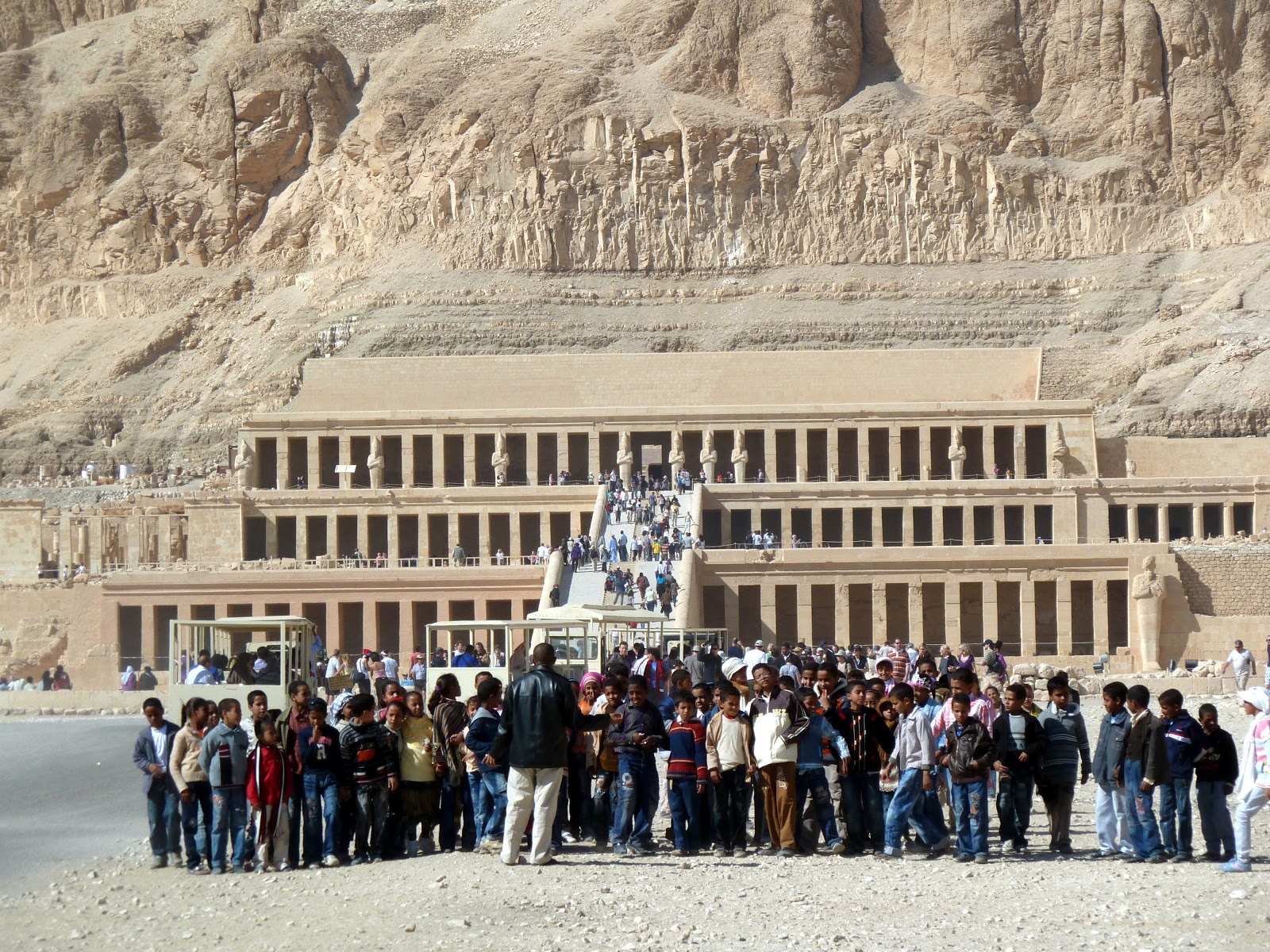
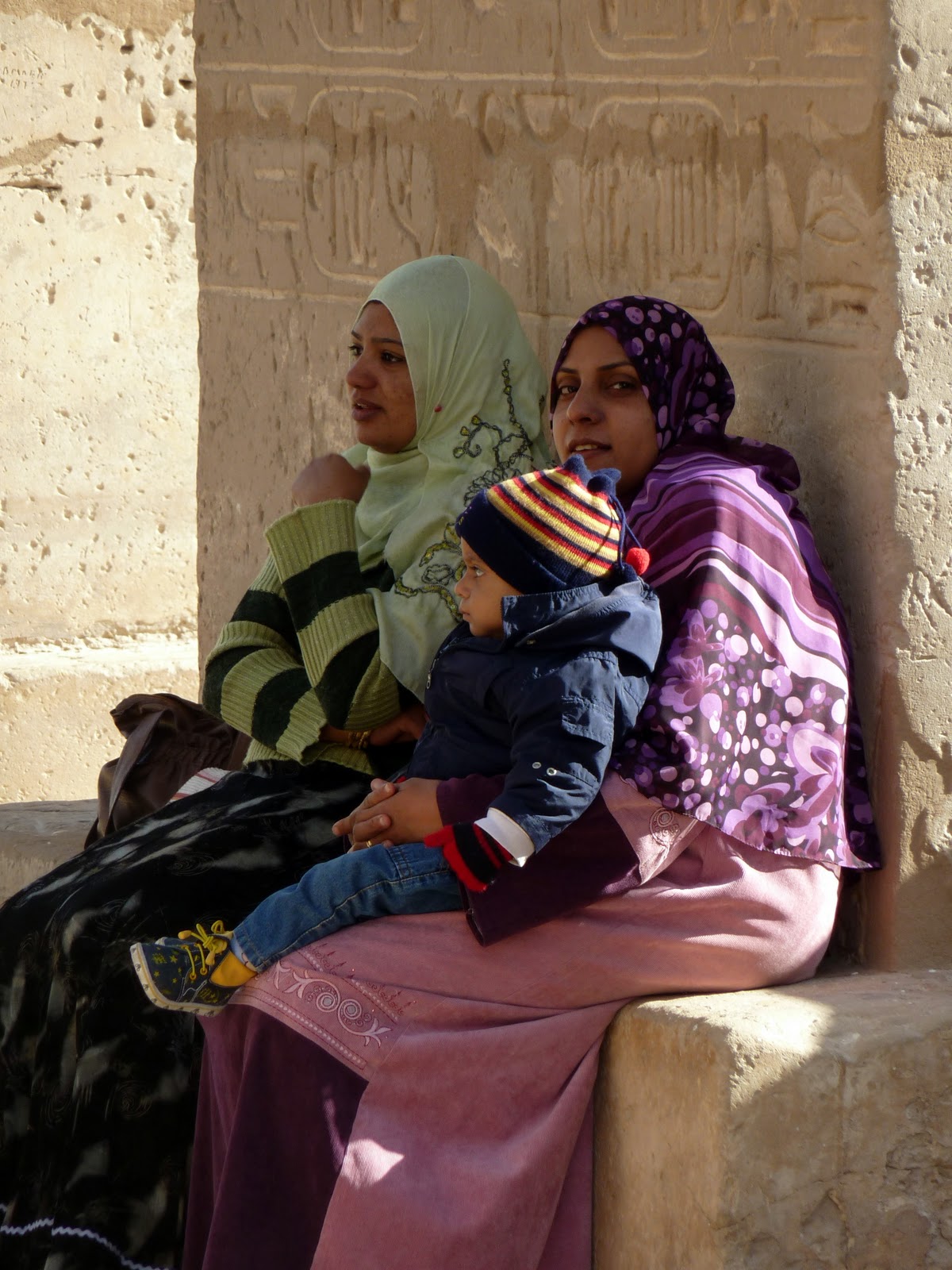
Following the analogy of the rising and setting sun, people in ancient Egypt generally lived on the East Bank of the Nile and were buried on the West Bank (hence the pyramids of Giza, Saqqara and Darshur are all located on the West Bank). As a result, the two sides of the Nile at Luxor offer distinct sights for today's visitor: The East Bank, home to the living city of Thebes, boasts two glorious temple complexes, Karnak and Luxor, where ancient Thebans worshiped their gods. On the other side of the Nile, the West Bank is one of the world's most impressive graveyards, filled with colorful underground tombs and marvelous above-ground mortuary temples for the deceased Pharaohs. On both sides of the Nile, one of the most interesting aspects of visiting the sights was interacting with friendly local tourists, especially large groups of school children, who were particularly fascinated with little Amanda hanging out in the Baby Bjorn. There's also some beautiful scenery, local color and plenty of shopping opportunities along the way.
 |
| Small village on the West Bank |
 |
| View from our hotel on the East Bank |
 |
| Locals enjoying some R&R on the West Bank |
 |
| At a mosque on the West Bank |
 |
| Alabaster factory on the West Bank |
 |
| Salesman on the West Bank |
 |
| Another local scene on the West Bank |

A vast conglomeration of temples, Karnak was in its heyday the holiest place in Egypt and is today the largest ancient religious site in the world. The key difference between Karnak and most of the other temples in Egypt is the length of time over which it was developed and used. Construction on the site began as early as 2,000 BCE and continued until Greco-Roman times, as dozens of Pharaohs added their own touches - a new temple here, a new series of inscriptions there. A key part of the complex is devoted to Amun-Ra, a local Theban deity whose status rose to king of all the Egyptian gods - he was so powerful during the apex of his worship during the New Kingdom that some commentators (at least on the internet) have suggested that Egypt approached virtual monotheism despite the panoply of gods and goddesses. The architectural features found at Karnak are not necessarily unique among Egyptian temples, but the size, number and diversity of these features is astounding. Karnak eventually declined in importance and was mostly abandoned by the time Constantine the Great established Christianity as the official religion of the Roman Empire in the 4th century CE. Today, it's one of Egypt's major tourist attractions, and was also the site in December 2010 of the first ever "Kids' Council" (at least in our family) - where Jeremy and Talia and their cousins Hayley and Will gathered to hatch a secret plan to overthrow their parents and make such decrees as "We are now done seeing temples!", "It's time to go swimming at the hotel pool!" and "We want desert!"


 |
| "Get down from there!" (in Arabic) |
 |
| The "Kids' Council" |

Founded in the 15th century BCE, Luxor Temple was originally connected to Karnak by a three kilometer-long colonnade lined with hundreds of sphinxes. A large renovation project is currently underway to excavate the colonnade, move modern residences, roadways and structures out of the way, and restore the colonnade to its original condition. At the entrance to Luxor Temple, one of the two towering obelisks is missing - in 1829, Muhammad Ali Pasha, the ruler of Egypt, gave the obelisk as a gift to France, who put it in the center of the Place de la Concorde in Paris, where it still resides. (Apparently, Muhammad Ali offered the other obelisk to France as well, but thankfully the task of transporting it proved too challenging and it remains in its original home.) Luxor Temple was built in large part by two of the most celebrated Egyptian Pharaohs - Amenhotep III, a magnanimous patron of the arts whose near 40-year reign was one of the peaks of Egyptian power, and Ramesses II, who was famously portrayed by Yul Brynner in Cecil B. DeMille's 1956 epic film,
The Ten Commandments (which I've seen about 10 times). Some of the most interesting features of the temple, however, are of a more recent vintage. It was used as a church during the Early Christian era and you can still see colorful paintings on the walls from this period. There's also an active mosque that was built on the temple's foundations about a 1,000 years ago, after the temple had been covered by centuries of shifting sands, which explains why today the original entrance to the mosque is well above ground level. The resulting mix of architectural styles and historical references is a fascinating blend of the millenniums.
 |
| My brother Steven with baby Amanda |
 |
| Gotta have the closeup shot! |
 |
| Early Christian painting |
 |
| The mosque at Luxor Temple |
 |
| And the closeup shot |
 |
| You'll have to go to Paris to see the other obelisk |
Moving to the West Bank of the Nile, the Valley of the Kings contains 64 tombs and was the principal burial place of the major royal figures of the New Kingdom, along with a number of privileged nobles. The tombs were carved deep into the rock in an effort to protect the Pharaoh's belongings in the afterlife, but many of the tombs were discovered and looted long ago. Indeed, archeologists have discovered ancient graffiti in Greek, Latin, Phoenician, Cypriot, Lycian, and Coptic (among other languages), and in 1799 Napoleon's expedition drew maps and plans of the known tombs. But the tombs are still decorated with colorful scenes from Egyptian mythology and give important clues of the beliefs and funerary rituals of the period. The most famous tomb is obviously that of Tutankhamun. Although he died young and ruled for only about a decade, the discovery of his tomb in 1922 by Howard Carter received worldwide press coverage and sparked a renewed public interest in ancient Egypt. The artifacts from this single tomb fill many of the exhibit rooms in the Egyptian Museum in Cairo. The nearby Valley of the Queens contains tombs of the kings' wives and offspring, with brightly colored interior decorations that are as striking as those in the Valley of the Kings. Photography is no longer allowed inside the tombs, but here are some images I pulled off the internet (including two from a really cool website called the "Theban Mapping Project") to give you an idea of the types of decorations that the ancient Egyptians used.


In addition to the royal tombs, the West Bank boasts a number of extremely impressive mortuary temples dedicated to important Pharaohs of the New Kingdom. The most imposing of these is undoubtedly the Temple of Hatshepsut, a terraced, colonnaded temple carved dramatically into the steep hillside with some amazingly colorful artwork. Hatshepsut, who ruled in the 15th century BCE, is generally regarded as one of the most successful Pharaohs, as she ushered in a long period of peace and prosperity, establishing trading relations that brought great wealth to Egypt. She used this wealth for a myriad of grand building projects and achieved an unprecedented level of artistic and architectural achievement. I've read that so much statuary was created during her reign that almost every major museum in the world has a statute of Hatshepsut or two among their collections - indeed, the Metropolitan Museum of Art in New York has an entire room dedicated to her.
 |
| Jeremy and baby Amanda make new friends |
 |
| Everyone loves baby Amanda! |
 |
| I like the suit and wool hat (and it's 80 degrees!) |
 |
| In Luxor, with Manhattan style! |
 |
| Say cheese! (in Arabic) |

We also visited the Ramasseum, the mortuary temple of Ramesses II, who ruled several hundred years after Hatshepsut, during the 13th century BCE. Ramasses ruled Egypt for 66 years and is regarded by many as the country's most celebrated and powerful Pharaoh (although Moses apparently got the better of him). Ramesses was a prolific builder, and he built on an epic scale. Early in his reign, Ramesses directed a very ambitious building project that transformed the ancient temples of Thebes so that each one eternalized him in stone. To do this, he changed the way that temple walls were inscribed, moving away from the elegant but shallow reliefs used by previous Pharaohs, which could be easily scratched out by their successors. Instead, he insisted on deeper engravings in stone, which were less susceptible to alteration. In a similar vein, he also built more colossal statues of himself than any other Pharaoh. Following the tradition of his predecessors, the art that covered the walls of his building projects served as propaganda to laud and embellish his military campaigns and political achievements. The Ramasseum was apparently just the beginning of his obsession with monumental construction (and with himself!) - just wait for Abu Simbel, which will be covered in our next post. The Ramasseum isn't as well preserved as some of the other ancient Egyptian temples, but the ruins at the site - surrounded by impressive mountain scenery on one side and lush farmland on the other, and teeming with locals doing excavation and restoration work (or just hanging out) - were very evocative.


Medinet Habu is another magnificent mortuary temple on the West Bank of Luxor. It is devoted to Ramesses III, who ruled in the 12 century BCE and is considered to be the last great ruler of the New Kingdom to wield any substantial authority over Egypt. The reliefs at Medinat Habu are outstanding, although the royal propaganda is particularly graphic, especially the disturbing images of the severed penises of Egypt's vanquished enemies. The site also includes ruins of a royal palace, with one of the oldest toilets I've ever seen. Needless to say, this place was a favorite for the kids, who joked incessantly about the "pile of penises" and the "royal potty." A fleet of hot air balloons in the clear morning sky added to the visual impact of the temple and its surroundings.
 |
| Hayley enjoying the royal palace |
 |
| Talia and Will enjoying the royal potty |
 |
| Remember Lorena Bobbit? |
 |
| See the hot air balloons in the background? |
The final sight that we visited in Luxor, before heading off on a cruise down the Nile, was the Colossi of Memnon, two gigantic statues of the Pharaoh Amenhotep III - all that remains of his mortuary temple. Built in the 14th century BCE, it was in its heyday the largest and most opulent temple complex in Egypt, bigger even than Karnak. I've come across several theories concerning the temple's destruction, involving earthquakes, floods, and deliberate dismantling by Amenhotep's successors.
The statues are named after Memnon, a hero of the Trojan War known as the "Ruler of the Dawn," because apparently a crack caused by an earthquake in 27 BCE caused one of the statues to make a singing sound at dawn. The base of this statue contains various inscriptions from ancient tourists testifying whether they heard the sound or not. The legend of the singing statue and the luck that hearing it was reputed to bring - combined with the belief in the statue's oracular powers - attracted a steady stream of visitors (including several Roman Emperors) until about 200 CE, when the Romans filled in the crack and the music stopped.
 |
| Once a magnificent temple, now farm fields |
Apart from their awe-inspiring scale and grandeur, what is most striking about the tombs and temples of Luxor is the level of artistry that the ancient Egyptians achieved during the New Kingdom. Intricate inscriptions, delicately colored reliefs and painted images, highly refined architectural designs, graceful statuary - it's not just monumental; it's creative, sophisticated and incredibly well executed. And it's more than 3,000 years old, remnants of what is perhaps the earliest artistic Golden Age in human history.