Wednesday, December 22, 2010

More From The West Bank: The Beautiful, But Troubled, City Of Hebron

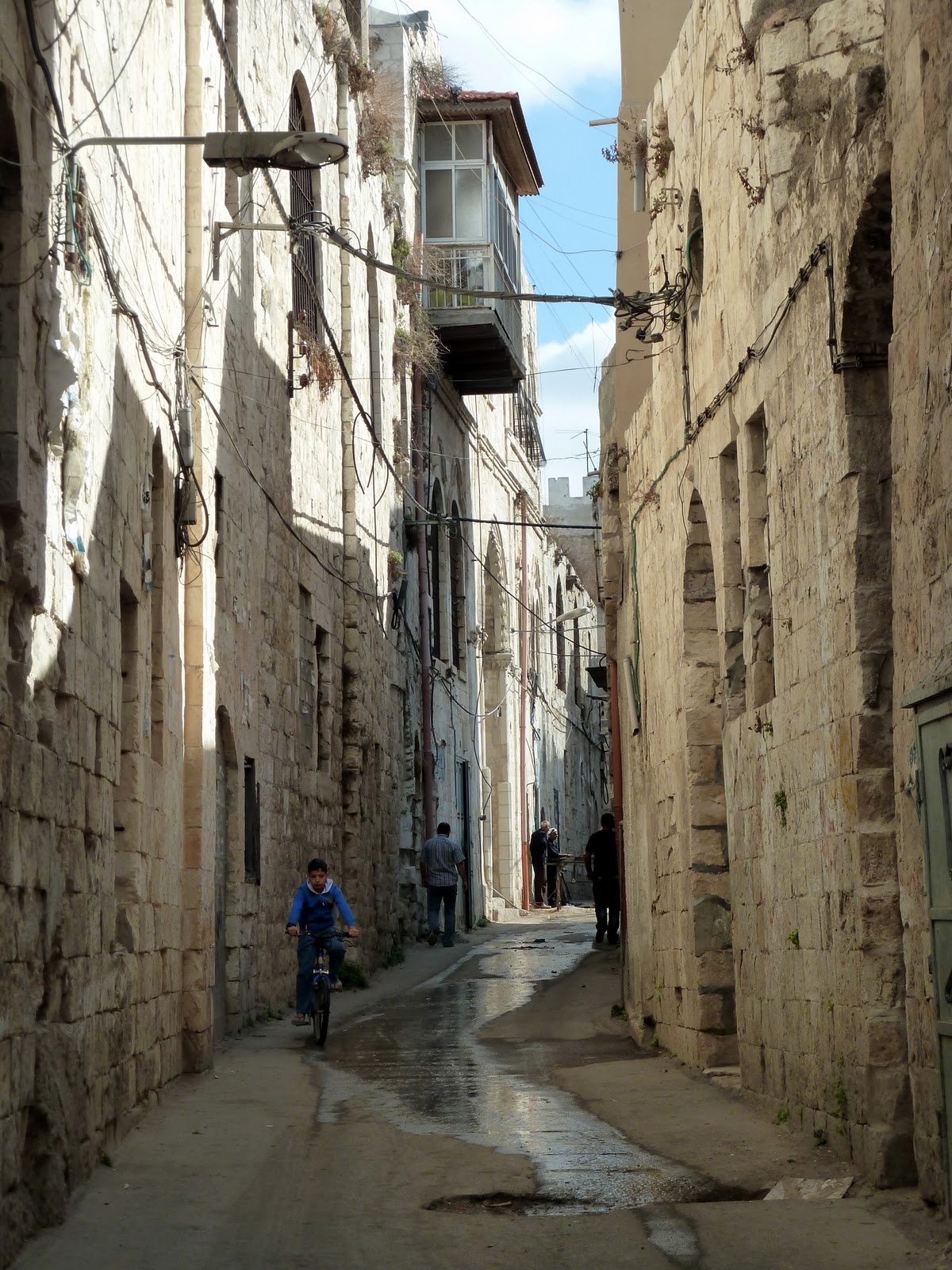
Old Hebron in H2 - stunningly pretty, but eerily empty
Hebron is not like other Palestinian cities. In Ramallah, Nablus, Jericho and Bethlehem, the Palestinian Authority has control over the city limits and Israeli citizens are prohibited (by the Israeli government, for security reasons) from entering. But Hebron is divided into two parts: H1, which consists of about 80% of the city and has a population of about 120,000, is under Palestinian administration. The remainder of the city is in H2, which is under Israeli control. H2 has a few hundred Jewish settlers, some 35,000-40,000 Palestinians, and a very heavy Israeli military presence.

The city is a holy place for both Jews and Muslims, as it houses the Tomb of the Patriarchs and Matriarchs (also known as the Cave of Machpelah to Jews and the Ibrahami Mosque to Muslims), where it is believed that Abraham and his wife Sarah, Isaac and his wife Rebecca, and Jacob and his wife Leah are all buried. (Jacob had another wife, Rachel, who is buried outside of Bethlehem.) Unfortunately, this ancestral commonality has not bred togetherness and has instead led to various murderous conflicts over the years. In 1929, Arab nationalists razed the Jewish quarter and killed dozens of Jews, forcing the Jewish community to flee the city.  Jews returned only after Israel took control of the West Bank in 1967.  More violence erupted in 1994, when American-born Baruch Goldstein opened fire in the mosque at the holy Tomb, killing 29 men and injuring several hundred others. And just a few months ago, four Jewish settlers in the neighboring town of Kiryat Arba were gunned down in cold blood while sitting in their car.

The Jewish presence inside the city certainly makes it easier to get to Hebron, as compared with other cities in the West Bank. I took the #160 bus from the main Jerusalem bus station right to the Tomb, which lies within H2, the Israeli-controlled part of town. There was one significant difference from other Israeli buses that I noticed almost immediately upon taking my seat: thick bullet-proof windows.

Like the city, the Tomb is divided, with separate entrances and prayer halls for Jews and Muslims - who come to honor the same biblical ancestors but do not interact with one another. After going through the security checkpoint on the Jewish side (I had to show my passport and they asked me to check any weapons that I was carrying), I entered the Tomb and said a prayer for peace.

Tomb of the Patriarchs & Matriarchs
Closeup shot
Panoramic shot
Historic building next to the Tomb

After my visit to the Tomb, I wanted to walk a bit around Hebron's Old City, which surrounds the Tomb. But an Israeli soldier stopped me and said it wasn't a good idea.  I went anyway, but in retrospect he was probably right. The historic architecture was stunning, but it was eerily quiet - as if I was suddenly in a ghost town.  Shop windows were shuttered, even though this had once been a thriving commercial district. Many houses were vacant, even though I was in the heart of the old city.  A group of young Arab boys gathered around me - at first, it seemed playful, but then they started pulling and hanging on me rather aggressively, and a particularly rambunctious little guy with a mischievous look on his face started to spit at me repeatedly.  Another boy - no older than Jeremy - was smoking a cigarette and started a small fire in a pile of garbage and rubble.  I started to feel uncomfortable at this point (for the first time in Israel), so I high-tailed it back to the Tomb.  But I was determined to continue on and see more of the city.  I walked the other way from the Tomb, on a broad street with plenty of Israeli soldiers. There was a lone jogger (an Israeli settler) and a few cars with Israeli license places (and several heavily armed military vehicles) raced by, but otherwise the street was utterly dead.  It was a spooky feeling, enhanced by the ubiquitous presence of barbed wire and concrete barriers. Just when I was wondering what else to do in town, a young Arab man named Islam started to walk with me and offered to take me on a tour of H1, the Palestinian-controlled area, which I hadn't seen yet. I walked with him for a bit, but at a certain point in the road there was a concrete barrier manned by an Israeli soldier and Islam stopped and said he wasn't allowed to go any further.

The beauty and emptiness of Hebron's Old City in H2

With some trepidation, I agreed to the tour.  Islam took me through a checkpoint into the H1 area, and there was an old neighborhood with stores, businesses and residences that at least had some semblance of normalcy.  Several people came up and said "Hello, welcome to Palestine!" and my discomfort of several moments earlier started to wane.  But as we walked through the city, Islam pointed out to me the security cameras and military watchtowers that lined the rooftops and hilltops.  We walked by more concrete and barbed wire, which separated H1 from H2.  We concluded our tour in an old Muslim cemetery on a hill that offered great views over the city. Islam showed me the path through the cemetery that Palestinians take to avoid checkpoints in the city in order to make it easier to go shopping, go to work, and get to school.


As I crossed back into H2 to make my way back to the bus stop to catch a bus to Jerusalem, I walked once more by a large line of eerily empty storefronts, some with overgrown vines, some that had been welded shut. There was some appalling Jewish graffiti, including a skull and cross-bones on a Palestinian house and a particularly disturbing note spray-painted in English that said: "Gas the Arabs!"  The irony of it was shockingly painful and I felt like crying.


I sat down at the bus stop next to a German tourist, who recounted her own difficulties in touring the city, including an encounter with an aggressive group of young Arab boys that made her feel extremely uncomfortable. She was leaving for Germany in the next few days, and she said that she was going to do her best to forget her traumatic visit to Hebron and take home with her instead the image of the West Bank she got from her visit to Bethlehem.

I don't mean to have any particular slant in writing this post, and it certainly was not an enjoyable one to write. I've tried merely to recount what I observed and how I felt at the time, in as neutral terms as possible. As our time in Israel winds down over the next few days, I'm going to try to do some mindless fun stuff with the kids, like go to the beach one last time, go to the beautiful Ramat Gan zoo, eat sushi, and share an ice cream sundae.  But I'll also try my hardest to keep the hope alive that one day peace will come to Hebron - and to Israel.

Tuesday, December 21, 2010

More From The West Bank: "Welcome To Palestine"

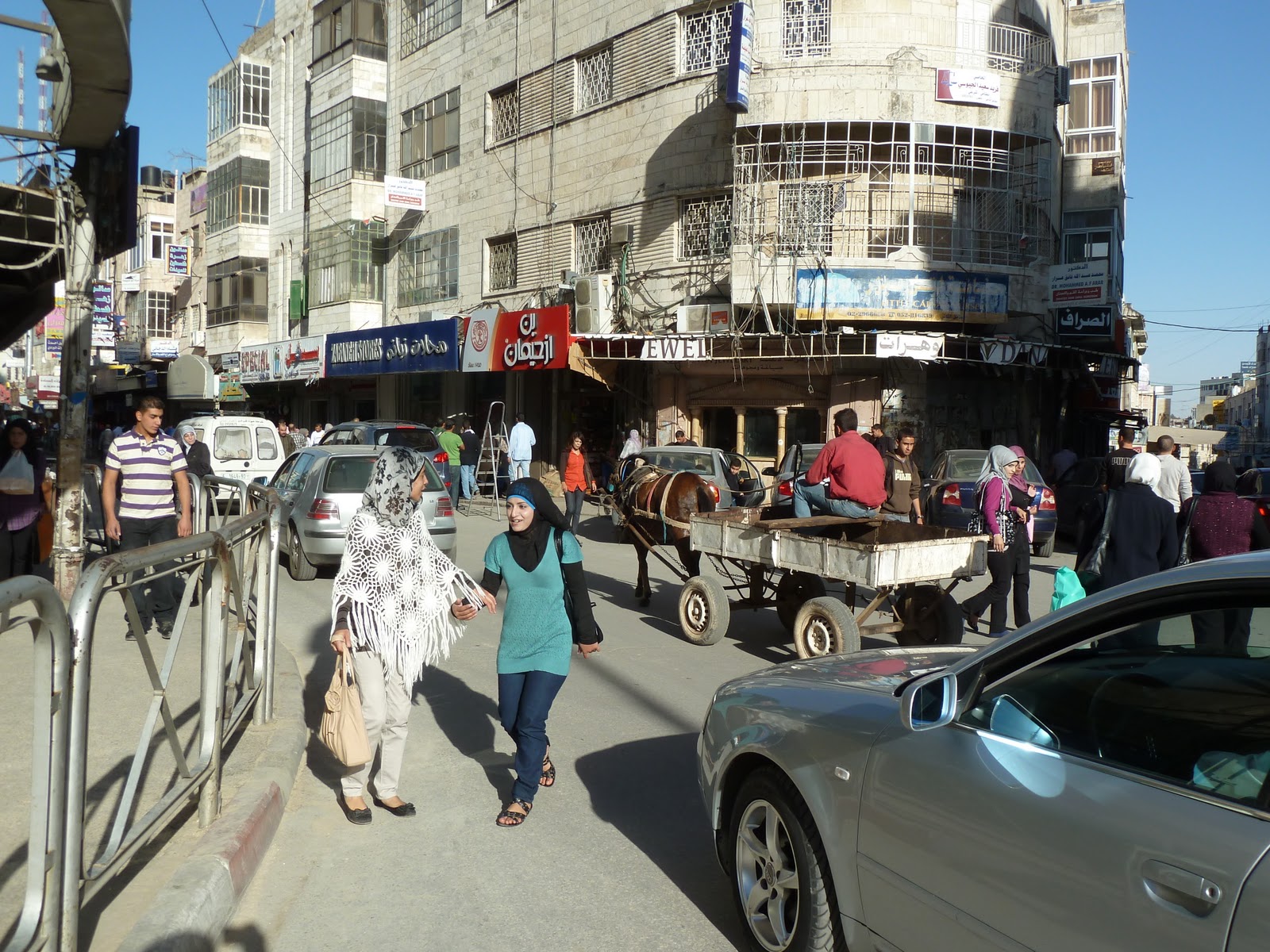
Street scene in Ramallah
In pretty much every place I visited in the West Bank, people stopped me on the street to say "Welcome to Palestine!"  I had friendly and engaging discussions with locals, and was offered free dates, bananas, oranges, biscuits, lessons in Arabic, suggestions on where else to visit in the West Bank, and advice on how to raise my children.  Traveling here was a memorable and rewarding experience - and vastly different from what I expected.    

I visited Ramallah three times, once to catch onward transport to Jericho, once to catch onward transport to Nablus, and once to visit the city in its own right.  Ramallah is the seat of the Palestinian Authority and the capital of Palestinian contemporary culture.  The main attraction in Ramallah is the busy central square and the lively streets that radiate from it.  There's a host of colorful storefronts; street vendors selling fresh-baked bread, fresh-squeezed juice, sweets and pastries, and fruits and vegetables; and plenty of family-run restaurants serving delicious Middle Eastern fare (think felafel, shawarma, rotisserie chicken and barbecued meat).  But the real treat is grabbing a streetside seat for a leisurely cup of strong Arabic coffee - I stuck to a traditional establishment, though I was tempted to try the "Stars & Bucks Cafe" as it seemed oddly familiar to me for some reason. 


It's the sweet tamarind juice guy!
There he is again!
Everyone loves Mickey Mouse!

After about a half-hour of prime people-watching, I had a long discussion with a Palestinian man who grew up in Ramallah but is now an American citizen who has lived in Chicago for the last 33 years.  The main topic of the discussion was a comparison of life in Ramallah with life in the United States.  While he acknowledged the freedom and economic opportunities that life in the U.S. offered, he lamented the disintegration of the family and the community in America.  In Ramallah, he said, children are free to wander the streets alone, because someone is always looking out for them.  Sure, there are poor people, he said, but they are fed by others in the community and you'll never see someone eating out of a garbage can.  There's so much less crime in Ramallah as compared with Chicago, he said, because family and social bonds are so much stronger, which creates a strong sense of shame in those who break those bonds - a shame that cannot be replaced simply by stiff prison sentences.

We also talked a bit about the "situation" in the West Bank.  He complained about the lack of freedom and economic opportunities for Palestinians, and said all he wanted for Palestinians was what Israelis have on the other side of the barrier.  He said he doesn't want violence (except if "someone messes with my wife or my daughters"), and that he wanted the Palestinians to be able to do business with the Israelis.  But he lamented the "politics" on all sides.  Finally, he opined that there's nothing else in the world that compares to Palestinian olive oil, which is why he had just spent hundreds of dollars at the post office to send large vats of the stuff back to Chicago.  He even had some in a plastic bottle that he was carrying with him, and he offered me a taste. 

During our streetside conversation, several people (who apparently recognized that I was a foreign tourist) walked by and said "Hello!" or "Welcome to Palestine!" (or both).  One man came up to me, smiled broadly and said "America!", opened a large plastic bag, gave me some fresh fruit to eat, and then continued on his way. 

Old City in Nablus
To get to Nablus, I asked a traffic officer in the middle of the street in Ramallah where the bus station was.  He immediately left his post and said:  "Follow me, I'll show you."  He walked with me a couple of blocks to the station, showed me which shared taxi to get into, told the driver that I was going to Nablus, and instructed me not to pay more than 15 shekels.  Arriving in Nablus, a businessman who was on his cell phone for the most of the hour-long ride from Ramallah asked me where in town I wanted to go.  I said "Al Qasaba" (the Old City) and he walked me to the entrance.  I said "shukran" (Arabic for thank you) and he responded "Welcome to Palestine!" before heading back in the direction where we had come from.  I was hungry for a small snack, so I asked a street vendor selling baked goods right at the entrance to the Old City how much one of his biscuits was - he just gave me one and said "Welcome!"   

I spent several hours wandering Nablus' atmospheric old city, which is filled with narrow lanes, historic buildings, lively markets, and friendly fruit vendors - one gave me a handful of dates for showing him the pictures of Nablus I had just taken on my camera; another gave me an orange and refused to accept any payment.  I made sure to eat some kanafeh, a syrupy vermicelli pastry filled with sweet cheese that is said to have originated in Nablus - according to many Palestinians, you should only eat kanafeh in Nablus; it's just not the same anywhere else.  As I was stopping to take a picture, a man who was walking by and talking on his cell phone stopped and interrupted his conversation to say "Welcome to Palestine!" 


Overlooking modern Nablus
I went to a coffee house overlooking the attractive main square of the modern part of town, and had another long conversation with a local Palestinian.  He asked whether we had mountains in California that were as tall as the moderately sized hill that was visible from the coffee house window.  He seemed shocked when I answered yes.  He lamented not being able to visit California, since he loved American movies and wanted very badly to see Hollywood.  Unfortunately, he said, he could never get a visa.  He was particularly enamored with "Titanic" - he said he could watch it everyday without tiring of it.   He asked who the star actress was, and I responded "Kate Winslet."  Rising in his seat excitedly, he loudly exclaimed:  "She has beautiful green eyes!"  I got the sense that he didn't want to talk about the situation in the West Bank, so I didn't press, although he did complain that the Palestinian Authority was corrupt and ineffective at the basic fundamentals of governance.  He tried to teach me some Arabic and he tested his English, which was pretty good (certainly much better than my Arabic!).  When I told him I had eaten some delicious felafel in town just before my visit to the coffee house, he said, laughing:  "Felafel is ok, but the only real food is meat.  Just meat!"  When I told him that I would soon be visiting Jericho, he said:  "Don't go there, it's too hot and dusty and there aren't any good coffee houses.  Come back to Nablus instead!  Or go to Ramallah.  They have nice coffee houses in Ramallah."  As our discussion, and my stay in Nablus, came to a close, he went out of his way to walk me to the bus station, and he urged me not to take a shared taxi back to Ramallah.  "The bus is only 10 shekels, but a shared taxi is 15 shekels.  You should spend the extra five shekels on your children.  It's important to buy things for your children!"

There is, however, something distinct - and ominous - about Nablus, as compared to other Palestinian cities.  Nablus was a flashpoint of violence during the Second Intifada and to this day "martyr" posters and placards are noticeably visible everywhere in town, hanging on walls, in doorways and from streetlamps.  I didn't see a single such poster during my wanderings in Ramallah, Bethlehem or Jericho.  It's a stark reminder of the political realities in Nablus, where many people support Hamas, not the Fatah-controlled Palestinian Authority.

Man walking under a martyr poster in the Old City
Martyr poster hanging prominently in the center of modern Nablus
I don't know what it says, but I think I have an idea


Herod's man-made mountain, with ground-level ruins in the forground
One can escape the troubles of the West Bank - for a moment at least - at Herodium National Park near Bethlehem.  (Click here to read about our family visit to the city of Bethlehem.)  Herod the Great built a remarkable fortress-palace-royal country club here some 2,000 years ago atop a large artificial hill made from massive amounts of earth.  Being the modest guy that he was, he named it after himself and made sure there were plenty of opulent gardens, swimming pools and bathhouses.  There are extensive ruins both at the foot and the top of Herod's man-made hill.   

There's also a bit of Jewish history associated with Herodium.  During the Great Revolt of the Jews against the Romans in the 1st century, the Jewish rebels established a base here and constructed a synagogue. During the Bar Kokhba Revolt in the 2nd century, Jewish fighters built a water system and a series of tunnels in the hill.  For today's tourist, the panoramic views from the top are as impressive as the ancient history.  


A giant crater in the top of the hill houses the ruins of an extensive palace complex
Behind his back, I think they called him "Big Head Herod"
View of ground-level ruins from the top of the hill
Panoramic view from the top of the hill
Panoramic view #2


Herodium didn't last and is now in ruins, but Mar Saba is still kicking.  Founded by Greek Orthodox monks in the 5th century in a remote desert canyon, Mar Saba is said to be one of the oldest inhabited monasteries in the world.  It's about a 45-minute ride over dry, rugged terrain from Bethlehem.  When I arrived, someone at the entrance said the Monastery was closed.  After several minutes of vigorous pleading by both me and my Palestinian taxi driver, the entrance guard rang a large bell and a monk arrived several moments later.  It was none other than Brother Lazarus from San Francisco, who was very pleased to hear that I lived for several years only a few blocks from the gold-domed Russian Orthodox church on Geary Boulevard.  After some schmoozing about the Bay Area, he not only let me in, but gave me a personalized tour.  Good ole Bro Lazarus to the rescue!

At Mar Saba with my Palestinian taxi driver
Scenic view from Mar Saba


Before coming to Israel, I was quite reticent and unsure about traveling in the West Bank.  But in retrospect, I can't imagine passing up the chance to visit.